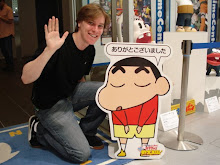
東京に帰りました!東京は大好きですから、アメリカに帰った時、東京を慕えます。
今日は東京ドームに行きました。東京ドームで別の初年ジャンプの舗がありました。この舗で私は何でもを買わなかったですけど、クラスメートは何でもを買いました。私は何でも買いたいですけど、お金がありませんでした。
次にポケモンセンターがあったから、浜松に行きました。ケエティちゃんはポケモンが大好きです。それから、ケエティちゃんはたくさんポケモンの商品を買いました。ポケモンのお菓子がありました。ポケモンセンターでルカリオを会いました。
ポケモンセンターの後で、原宿に帰りました。原宿でお土産を買いました。このお土産はシャツでした。
次に、ケエティちゃんはゲーム舗を見つけたから、巣鴨に行きました。巣鴨に行ったけど、ゲーム舗がありませんでした。その代わり、CD舗に行きました。このCD舗は何でもを買いませんでした。後で晩御飯を食べました。晩御飯は鶏肉を食べました。鶏肉はとても美味しいでした!
Vocabulary:
湿った(wet)
縫いぐるみ(stuffed animal)
冒険(adventure)
使命(mission)
鶏肉(Japanese grilled chicken skewers)
駅長(station master)
混合酒(cocktail, mixed drink)
商品(merchandise)
ドーナツ(doughnut)
仮想(costume, disguise)
Cultural Notes:
1. Station masters in Tokyo know where absolutely everything can be found.
2. Some Japanese mixed drinks are much different than the ones in the States. I had a cocktail made with Calpis. Delicious!
3. You can get anywhere in Tokyo on a train.
Wednesday, July 1, 2009

10日:宮島
今日は宮島がいました。宮島とても面白いですけど、宮島の鹿はとても忌々しいです。今日の朝はみせんに行きました。みせんは山です。この山でたくさん寺がありました。も、たくさん仏陀の像がありました。ハイキングは好きですから、みせんに上りました。山の森はとてもきれって、面白い人を会いました。山で年配の人や学生や先生がいました。山頂ですごいなビューがありました。いつか、この山に帰りたいです。


も、お鳥居を見ました。この鳥居はとても大きくて、とても古いです。今、東京に帰ります。
Vocabulary:
山頂(summit of a mountain)
潮(tide)
馬小屋(horse stable)
階段(stairs)
麦藁蜻蛉(dragonfly)
一休み(a rest)
下駄(traditional Japanese sandals)
完遂(accomplish)
手すり(handrail, railing)
里程標(milestone)
Cultural Notes:
1.Old people in Japan are in very good shape. A whole group of them went by on the way up the mountain.
2.In Japan, hiking is simply climbing stair outdoors. Lots and lots of stairs.
3.There are concession stand on mountain summits.


も、お鳥居を見ました。この鳥居はとても大きくて、とても古いです。今、東京に帰ります。
Vocabulary:
山頂(summit of a mountain)
潮(tide)
馬小屋(horse stable)
階段(stairs)
麦藁蜻蛉(dragonfly)
一休み(a rest)
下駄(traditional Japanese sandals)
完遂(accomplish)
手すり(handrail, railing)
里程標(milestone)
Cultural Notes:
1.Old people in Japan are in very good shape. A whole group of them went by on the way up the mountain.
2.In Japan, hiking is simply climbing stair outdoors. Lots and lots of stairs.
3.There are concession stand on mountain summits.
9日:広島と宮島
 今日の朝は広島に行きました。広島で広島平和記念資料館に行きました。この博物館は1955に建てられました。この博物館の中に原子爆弾の陳列品があります。このところはとても暗澹でしたけど、使命は平和でした。
博物館に出したの時、広島駅に帰りました。別の電車に乗りました。電車の後でフェリーに乗った、宮島に行きました。宮島は小さいですけど、とてもきれい島です。宮島でたくさん鹿がありますけど、この鹿はとてもけちでした。あるとき、鹿は私のセーターに齧りました!


宮島で旅館に留めました。このところはとてもいいですけど、違いました。私の部屋の中に布団でした。私は始めて日本の布団を使いました。アメリカの布団はとても違いです。夜はお鳥居を見えましたこの鳥居はとても大きくて、とても有名です。後で旅館に帰った、浴衣を着ました。浴衣は清くて、とても格好いいです。残念ながら、私の浴衣は小さいでした。
Vocabulary:
滅亡(ruin, destruction)
平和(peace, harmony)
太鼓(drum)
壁画(mural)
宣伝(advertisement)
範(example, model)
旅館(Japanese style inn)
浴衣(summer kimono)
浴場(bath-house)
鹿(deer)
Cultural Notes:
1.Japanese inns are very expensive but very comfortable.
2.Yukata can be worn around the inn, to go to the bath and to hang out with other guests..
3.Public baths would be considered strange in the States, but in Japan they are totally normal... and awesome.
Tuesday, June 30, 2009
8日:京都
 今日は、京都で最終日です。私たちはたくさん寺とたくさん社を見えました。まず、平安神宮に行きました。平安神宮の鳥居はとても大きくて、赤いです。この大きい鳥居は、上に道です。も、平安神宮は大きくて、赤いです。
次に、金閣寺に行きました。金閣寺でたくさん観光客がいました。観光客は日本人と外国人がいました。金閣はとてもきれいですから、長い時歩きました。後で、アイスクリームを食べました。バニラアイスクリームは大好きです。


京都駅で晩御飯を食べた後で、ビックカメラに行きました。日本の携帯電話を見た、ケイタイを買いたいけど、買いませんでした。
7日: 京都
今日の朝は、も新幹線に乗って、京都に行きました。京都に至った時、清水寺に行きました。清水寺でたくさん学生と先生がいました。清水寺はとても面白いですけど、とても暑いでした。清水寺で、日本の学生に会いました。学生は宿題がありましたから、ブライアン訓と私に質問を聞きいただきました。


跡で、京都駅に帰りました。京都駅はとても大きいですけど、夜時、とてもきれいです。京都駅の中にレストランで晩御飯を食べた、ホテルに帰りました。
Vocabulary:
丘陵(hill)
白日(bright sunshine)
塔(tower, pagoda)
おみくじ(paper fortunes)
修学旅行(student field trip)
梵僧(monk)
入場料(admission fee)
滝(waterfall)
池(pond)
原付(moped, scooter)
墓場(cemetery)
Cultural Notes:
1.Japanese schools appear to take a lot of school field trips
2.Cats a fairly rare in Japan.
3.Even monks have to go shopping.


跡で、京都駅に帰りました。京都駅はとても大きいですけど、夜時、とてもきれいです。京都駅の中にレストランで晩御飯を食べた、ホテルに帰りました。
Vocabulary:
丘陵(hill)
白日(bright sunshine)
塔(tower, pagoda)
おみくじ(paper fortunes)
修学旅行(student field trip)
梵僧(monk)
入場料(admission fee)
滝(waterfall)
池(pond)
原付(moped, scooter)
墓場(cemetery)
Cultural Notes:
1.Japanese schools appear to take a lot of school field trips
2.Cats a fairly rare in Japan.
3.Even monks have to go shopping.
6日: 豊川と名古屋
今日は、名古屋に帰るつもりでした。でも、まず、豊川の稲荷の神社に行きました。この神社で、たくさん狐の像がありました。も、この神社は仏教の寺です。寺の中に、きれいな仏陀の像がありました。


次に、名古屋に帰りました。もっぺん、Oasis21に帰りました。も、初年ジャンプの舗に帰って、ドラゴンボールのシャツを買いました。子供のとき、ドラゴンボールは大好きでした。 今日は、ベースボールのゲームがありました。名古屋のチームは中日ドラゴンズです。ドラゴンズは、ナゴヤドームでプレーしました。ボストンのように、名古屋の人はベースボールが大好きです。
ナゴヤドームで、お金は要りましたから、ATMに行きました。時々、日本のATMはアメリカのカードにオミットします。
次に、新幹線に乗りましたけど、違うの新幹線祈りました。遅いですから、晩御飯を欠かしました。でも、鈴木先生の家族はとても懇ろですから、すしのレストランに誘いました。もっぺん、晩御飯はとてもおいしくて、楽しかったです。鈴木先生の家族、ありがとうございます!
Vocabulary:
稲荷(Shinto god of the harvest)
亀(turtle)
中日ドラゴンズ(Chunichi Dragons, the Nagoya baseball team)
乗り損なう(to miss a train)
野球(Japanese term for baseball)
現金自動預け払い機(ATM)
運動公園(athletic park, stadium)
野球帽(baseball cap)
Cultural Notes:
1.People in Nagoya love baseball (a lot like the people in Boston love baseball).
2.ATM that accept American debit cards are very hard to find in Japan.
3.If you get on the wrong train there is always another one to get you back where you were.


次に、名古屋に帰りました。もっぺん、Oasis21に帰りました。も、初年ジャンプの舗に帰って、ドラゴンボールのシャツを買いました。子供のとき、ドラゴンボールは大好きでした。 今日は、ベースボールのゲームがありました。名古屋のチームは中日ドラゴンズです。ドラゴンズは、ナゴヤドームでプレーしました。ボストンのように、名古屋の人はベースボールが大好きです。
ナゴヤドームで、お金は要りましたから、ATMに行きました。時々、日本のATMはアメリカのカードにオミットします。
次に、新幹線に乗りましたけど、違うの新幹線祈りました。遅いですから、晩御飯を欠かしました。でも、鈴木先生の家族はとても懇ろですから、すしのレストランに誘いました。もっぺん、晩御飯はとてもおいしくて、楽しかったです。鈴木先生の家族、ありがとうございます!
Vocabulary:
稲荷(Shinto god of the harvest)
亀(turtle)
中日ドラゴンズ(Chunichi Dragons, the Nagoya baseball team)
乗り損なう(to miss a train)
野球(Japanese term for baseball)
現金自動預け払い機(ATM)
運動公園(athletic park, stadium)
野球帽(baseball cap)
Cultural Notes:
1.People in Nagoya love baseball (a lot like the people in Boston love baseball).
2.ATM that accept American debit cards are very hard to find in Japan.
3.If you get on the wrong train there is always another one to get you back where you were.
5日: 名古屋
 今日は、もう一遍、新幹線に乗りました。豊川の隣ですから、名古屋に行きました。名古屋で、ケティちゃんは行きたいでしたから、ポケモンセンターに行きました。ポケモンセンターの隣に初年ジャンプの舗がありました。この舗で、ドラゴンボールのシャツを買いました。
次に、ちあき先生は会いました。ちあき先生は名古屋に住んでいます。雨が降りましたけど、ちあき先生と一緒に名古屋城に行きました。名古屋城はとても大きいです。この城の中に、たくさん庭園があります。天守に入って、たくさん写真を写しました。雨が降りましたのに、とてもきれいでした。


次に、豊川に帰りました。豊川で、鈴木先生の家族に会いました。鈴木先生の家族はとても懇ろですから、私たちと一緒に晩御飯を食べました。焼肉を食べていました、食べ物はとてもおいしかた。この晩御飯はとても楽しかったです。
Vocabulary:
愛好者(fan, enthusiast)
櫓(castle tower, turret)
庭園(garden)
石造り(made of stone)
茶室(teahouse)
門(gate)
水城(an early type of moat)
南蛮(Europeans, especially invaders)
ひさし(eaves of a roof)
壁(wall)
Cultural Notes:
1.Japanese castle grounds are large and have many gardens and buildings.
2.Kyoto is famous for it's pork dishes.
3.Umbrellas are everywhere in Japan. You can borrow umbrellas from your hotel and there are tons of stores that sell all kinds of umbrellas.
Sunday, June 28, 2009
4日:豊川
今日は、豊川に行きました。初めて新幹線に乗りました。新幹線の中に、麗らかな春の日ですから、
富士山を見ました。富士山はとても大きいです。いつ新幹線に降りていました、狐の像は私たちを出迎えました。残念なことに、私は気分が悪いですから、クラスメートと一緒に晩御飯へ行きませんでした。その代わり、ホテルに居座りました。


3日: 東京
 今日は、原宿に戻りました。この時は、クラスメートと一緒に行きました。クラスメートは買い物しましたけど、私は買い物しませんでした。買い物して代わりに神社へ行きました。原宿で明治神宮があります。この神社はとても大きくて、とてもきれいです。神社でたくさん写真を撮りました。
神社の跡で、クラスメートと先生と一緒に江戸東京博物館に行きました。博物館の中にたくさん収蔵品がありました。も一度、たくさん写真を撮りました。

次に、秋葉原へ行きました。秋葉原のニックネームは秋葉です。秋葉原は面白いですけど、ちょっと変です。秋葉原でたくさんホビー屋がありますけど、私が買いたくなかったです。も、秋葉原でたくさん本屋とゲーム屋があります。
秋葉の過ぎに、鈴木先生とサラちゃんとオリバ君と一緒に池袋へ行きました。池袋で韓国の食べ物を食べました。韓国の食べ物が大好きです。私は、ブルゴギとキムチを食べました。末に、ホテルに帰りました。

Vocabulary:
博物館(Museum)
収蔵品(Artifact)
落書き(scribbles, graffiti)
樽(barrel)
お守り(charm, talisman)
制服(uniform)
手水や(purification fountain found at temples)
大小(literally “big and small”, a samurai's katana and wakizashi)
弓(Japanese longbow)
お勧め(recommendation)
Cultural Notes:
1.Even in the middle of Tokyo there are temples and shrines with beautiful parks.
2.Shrines and temples sell over-priced good luck charms. The “good luck on entrance exams” seems to be the most popular type.
3.The Japanese love Korean food as much as I do!
2日:東京

今日は、東京に行きました。 一時間ぐらい、電車に乗りました。 東京に到着しまたの跡で、ホテルに行きました。 それから、浅草に行きました。 浅草で買い物しました。 昼ごはんはデンイズでたべました。 私は漫画とウォッチとプレセントを買いました。
浅草の跡で、電車に乗って、渋谷に行きました。 渋谷はたくさん人がいますから、むずかし歩きました。 渋谷でたくさん買い物ですけど、とても高いでした。 も、はちこを見ました。

渋谷の跡で、原宿に行きました。 原宿もたくさん買い物ですけど、とても高くなっかたでした。 買い物は高くないですけど、私は買いませんでした。マクドナルドに行きました、私のバーガーがおいしくありません。

原宿の跡で、ホテルへ帰りました。ホテルでお風呂に入りました。お風呂の跡で宿題をしました。跡で、コンビニに行ってお菓子を買いました。最後に、寝ました。
Vocabulary:
きょじん(Giant)
きぞう(A present, gift, donation)
きかんぼう(An unruly child)
ぼうきれ(A stick, broken piece of wood)
きぼう(Hope, wish)
アサヒ(a Japanese beer/drink company)
百貨店(Department store)
うまい(skillful, clever, wise)
カルピス(a Japanese soft drink)
地下鉄(subway, underground train)
Cultural Notes:
1.There are Denny's restaurants in Japan. However, they are much different than American Denny's.
2.Many trains have a mascot that reminds people to beware of the closing train doors.
3.In Japan you are either in a town/city, in the mountains or on a rice patty.
Tuesday, May 12, 2009
1日:日本でいます!
こんばんわ。
Finally, after many months/weeks of preparation and waiting we are at last in Japan. We arrived at Narita airport earlier this afternoon after a grueling 13 hour flight from Washington D.C. Not only did we have to endure a 13 hour flight in a very uncomfortable Boeing 777 but when we finally touched down in Narita and were all ready to get off they sent in a medical team (in full haz-mat gear) to find out if anyone on the plane had contracted Swine Flu recently. This led to another hour of waiting and doing nothing. Luckily, we all escaped quarantine.

Finally off the plane we got our bags and changed our money and got out of the airport. The hotel for the night was close to the airport and right next to the train station. After check in we went to our rooms to shower and get ready for dinner. The rooms at this hotel (as with many hotels in Japan) are tiny. Like barely-able-to-walk-in tiny.

For dinner I went to a Japanese ramen chain restaurant with Suzuki-sensei and some of my classmates. Here I found something they I didn't even know I was looking for: kimchee ramen. That's right: two of the greatest edibles together as one in a symphony of hot and spicy delicious deliciousness.
On the way home from dinner I stopped at the convenient store (コンビに) and got a few staples of Japanese convenient store food.

Haichu (ハイチュウ), Bulgaria Yogurt (ブルガリア) and the superbly named beverage Calpis (say it aloud). Haichu is a candy, kind of like Starburst in the US except it starts soft and chewy (kinda of like a Starburst that has been in the sun too long). Bulgaria Yogurt was a recommendation from Suzuki-sensei, and was delicious. Yogurt in Japan is a lot sweeter than in the US. Calpis is one of the single greatest beverages I have ever had. It looks awful, has a horrible name and comes in a square shaped bottle but somehow it works. It kind of tastes like a light citrus water with a slightly smooth texture like low-fat milk.
After some tasty treats it was finally time for some sleep. Tomorrow we travel to
Tokyo.
Finally, after many months/weeks of preparation and waiting we are at last in Japan. We arrived at Narita airport earlier this afternoon after a grueling 13 hour flight from Washington D.C. Not only did we have to endure a 13 hour flight in a very uncomfortable Boeing 777 but when we finally touched down in Narita and were all ready to get off they sent in a medical team (in full haz-mat gear) to find out if anyone on the plane had contracted Swine Flu recently. This led to another hour of waiting and doing nothing. Luckily, we all escaped quarantine.

Finally off the plane we got our bags and changed our money and got out of the airport. The hotel for the night was close to the airport and right next to the train station. After check in we went to our rooms to shower and get ready for dinner. The rooms at this hotel (as with many hotels in Japan) are tiny. Like barely-able-to-walk-in tiny.

For dinner I went to a Japanese ramen chain restaurant with Suzuki-sensei and some of my classmates. Here I found something they I didn't even know I was looking for: kimchee ramen. That's right: two of the greatest edibles together as one in a symphony of hot and spicy delicious deliciousness.
On the way home from dinner I stopped at the convenient store (コンビに) and got a few staples of Japanese convenient store food.

Haichu (ハイチュウ), Bulgaria Yogurt (ブルガリア) and the superbly named beverage Calpis (say it aloud). Haichu is a candy, kind of like Starburst in the US except it starts soft and chewy (kinda of like a Starburst that has been in the sun too long). Bulgaria Yogurt was a recommendation from Suzuki-sensei, and was delicious. Yogurt in Japan is a lot sweeter than in the US. Calpis is one of the single greatest beverages I have ever had. It looks awful, has a horrible name and comes in a square shaped bottle but somehow it works. It kind of tastes like a light citrus water with a slightly smooth texture like low-fat milk.
After some tasty treats it was finally time for some sleep. Tomorrow we travel to
Tokyo.
Wednesday, April 8, 2009
インターネット物:日本の独創性
What do you do when you really want to surf but you are miles and miles from the nearest beach and all you have is a giant warehouse? Well, apparently the Japanese answer would be "build a beach".

Photo: http://www.seagaia.co.jp/english/od/od.html
Funny thing is the beach they built is located in the coastal city of Miyazaki, only a 5 minute drive from the actually ocean. Aparently, this place holds the Guinness World record for being the world's largest indoor water park (300m by 100m). From the maps (as seen on Google Earth) it looks like there are plenty of beaches in the area. You would think something like this would be built in a landlocked and/or cold city like Sapporo in Hokkaido. I guess if it were raining and you were a busy Japanese family on a rare weekend holiday to the seaside then the Ocean Dome would be a way to salvage the weekend. This is an interesting, if not exactly necessary, piece of engineering. Another cool note: the roof retracts (like a stadium roof in the US) for those nice, sunny days.
Hopefully I will get to see some cool works of engineering like this when I am in Japan.
Funny thing is the beach they built is located in the coastal city of Miyazaki, only a 5 minute drive from the actually ocean. Aparently, this place holds the Guinness World record for being the world's largest indoor water park (300m by 100m). From the maps (as seen on Google Earth) it looks like there are plenty of beaches in the area. You would think something like this would be built in a landlocked and/or cold city like Sapporo in Hokkaido. I guess if it were raining and you were a busy Japanese family on a rare weekend holiday to the seaside then the Ocean Dome would be a way to salvage the weekend. This is an interesting, if not exactly necessary, piece of engineering. Another cool note: the roof retracts (like a stadium roof in the US) for those nice, sunny days.
Hopefully I will get to see some cool works of engineering like this when I am in Japan.
準備2:振り仮名!
今晩は。
I have trouble reading kanji. I think every non-native Japanese speaker/reader does. I found a few useful tools on the internet today that add the option of inserting 振り仮名[ふりがな](furigana) into text in a couple of programs that I use everyday.
I use Mozilla Firefox as my main browser for surfing the internet and I have discovered an add-on that allows the user to turn on furigana on any website with Japanese text. This is very useful for people like me who have a hard time remembering kanji pronunciations but still like to visit Japanese websites.
To get the Furigana Injector add-on first you have to download and install it here. Next, download and install the XHTML Ruby Support Add-on here. This add-on will allow the Furigana Injector add-on to place furigana above the kanji, without it the furigana will show up in parenthesis next to the kanji which is quite difficult to read.
Once these are installed, restart Firefox and a small button marked "振" will appear at the bottom right of your browser window. Navigate to a site with Japanese text, click the little button and voila: furigana appears above the kanji on the page. The settings for the addon can be tweaked by right-clicking the little button and choosing options. I haven't really looked into these options too in depth because the basic settings seem to be working for me so far.
The second furigana related add-on I have found is for OpenOffice.org 3.0. This is an open source (meaning free!) office suite, similar to Microsoft Office (though I have found it to be better in some ways and worse in others). I use OpenOffice Writer to type up my homework, essays, writing assignments, letters etc. One problem I have had with doing my Japanese homework in OpenOffice is that I couldn't insert furigana. This becomes a problem when I get to class and try to read my homework, but have forgotten how to read the kanji I had used. Very frustrating, but no more!
To enable the furigana insert feature in OpenOffice Writer open the program and click Tools -> Options. In the pop-up box select Language Settings -> Languages on the left side menu. In the Languages options, check the box labeled "Enabled for Asian Languages" under the "Enhanced Language Support" heading. Next, under the "Default Languages for Documents" heading select Japanese from the drop down menu for Asian.
Unfortunately, this feature does not automatically insert furigana for you, it must be done manually for each kanji you want labeled with furigana. Luckily the process of doing so is simple. Highlight the kanji you want to label and click Format -> Asian phonetic guide (or use the the Windows keyboard shortcut Alt+o+i). In the pop-up box type the hiragana pronunciation in the text box directly to the right of the kanji you are editing and click Apply and then Close. By default this should place furigana above the selected kanji. The settings can be tweaked in the Format -> Asian phonetic guide pop-up box if necessary.
I have already used both the OpenOffice add-on and the Firefox add-on and so far they both work well. The Firefox add-on has a few issues with putting the proper furigana over a few different kanji though, which can be irritating. I don't think there is a better option but I will try to find ont. I am sure both add-ons will be updated with better features in the future so I will keep checking them for updates as well.
I have trouble reading kanji. I think every non-native Japanese speaker/reader does. I found a few useful tools on the internet today that add the option of inserting 振り仮名[ふりがな](furigana) into text in a couple of programs that I use everyday.
I use Mozilla Firefox as my main browser for surfing the internet and I have discovered an add-on that allows the user to turn on furigana on any website with Japanese text. This is very useful for people like me who have a hard time remembering kanji pronunciations but still like to visit Japanese websites.
To get the Furigana Injector add-on first you have to download and install it here. Next, download and install the XHTML Ruby Support Add-on here. This add-on will allow the Furigana Injector add-on to place furigana above the kanji, without it the furigana will show up in parenthesis next to the kanji which is quite difficult to read.
Once these are installed, restart Firefox and a small button marked "振" will appear at the bottom right of your browser window. Navigate to a site with Japanese text, click the little button and voila: furigana appears above the kanji on the page. The settings for the addon can be tweaked by right-clicking the little button and choosing options. I haven't really looked into these options too in depth because the basic settings seem to be working for me so far.
The second furigana related add-on I have found is for OpenOffice.org 3.0. This is an open source (meaning free!) office suite, similar to Microsoft Office (though I have found it to be better in some ways and worse in others). I use OpenOffice Writer to type up my homework, essays, writing assignments, letters etc. One problem I have had with doing my Japanese homework in OpenOffice is that I couldn't insert furigana. This becomes a problem when I get to class and try to read my homework, but have forgotten how to read the kanji I had used. Very frustrating, but no more!
To enable the furigana insert feature in OpenOffice Writer open the program and click Tools -> Options. In the pop-up box select Language Settings -> Languages on the left side menu. In the Languages options, check the box labeled "Enabled for Asian Languages" under the "Enhanced Language Support" heading. Next, under the "Default Languages for Documents" heading select Japanese from the drop down menu for Asian.
Unfortunately, this feature does not automatically insert furigana for you, it must be done manually for each kanji you want labeled with furigana. Luckily the process of doing so is simple. Highlight the kanji you want to label and click Format -> Asian phonetic guide (or use the the Windows keyboard shortcut Alt+o+i). In the pop-up box type the hiragana pronunciation in the text box directly to the right of the kanji you are editing and click Apply and then Close. By default this should place furigana above the selected kanji. The settings can be tweaked in the Format -> Asian phonetic guide pop-up box if necessary.
I have already used both the OpenOffice add-on and the Firefox add-on and so far they both work well. The Firefox add-on has a few issues with putting the proper furigana over a few different kanji though, which can be irritating. I don't think there is a better option but I will try to find ont. I am sure both add-ons will be updated with better features in the future so I will keep checking them for updates as well.
Tuesday, April 7, 2009
準備1:日本で外人
今晩は。
In preparation for my upcoming trip to Japan I have been searching the internet to find interesting places, people, and things to see in Japan. Blogs, videos and stories from foreigners who have traveled to Japan are often a good source of information.
Today I ran across some videos of two American cable TV hosts (from G4's Attack of the Show) on a 24-hour whirlwind tour of Tokyo. One of the hosts, Kevin, is your average American male while his female counterpart, Olivia, has lived in Tokyo for much of her life and has even had a professional career in Japanese modeling. Kevin's complete lack of knowledge of Japanese culture is amusing, though luckily he is relatively respectful to the people and their society so he isn't giving off that "stupid American" vibe; even though he is American... and stupid.
Kevin visits a 相撲部屋 [すもうべや] (sumo stable):
It is interesting to see how people from a very traditional part of Japanese culture treat foreigners. I would be willing to bet that this particular sumo stable is used to having guests (especially celebrities) around, but it would seem that many of the traditional aspects of sumo life are well represented. Also, skinny white dudes look hilarious in a sumo outfit.
I personally know next to nothing about many aspects of traditional Japanese culture so it will be interesting to see how they will be represented in modern Japan.
NOTE: Holy crap!! They have Krispy Kreme in Japan?! First on my to-do list when I reach Narita Airport: find a Japanese Krispy Kreme.
In preparation for my upcoming trip to Japan I have been searching the internet to find interesting places, people, and things to see in Japan. Blogs, videos and stories from foreigners who have traveled to Japan are often a good source of information.
Today I ran across some videos of two American cable TV hosts (from G4's Attack of the Show) on a 24-hour whirlwind tour of Tokyo. One of the hosts, Kevin, is your average American male while his female counterpart, Olivia, has lived in Tokyo for much of her life and has even had a professional career in Japanese modeling. Kevin's complete lack of knowledge of Japanese culture is amusing, though luckily he is relatively respectful to the people and their society so he isn't giving off that "stupid American" vibe; even though he is American... and stupid.
Kevin visits a 相撲部屋 [すもうべや] (sumo stable):
It is interesting to see how people from a very traditional part of Japanese culture treat foreigners. I would be willing to bet that this particular sumo stable is used to having guests (especially celebrities) around, but it would seem that many of the traditional aspects of sumo life are well represented. Also, skinny white dudes look hilarious in a sumo outfit.
I personally know next to nothing about many aspects of traditional Japanese culture so it will be interesting to see how they will be represented in modern Japan.
NOTE: Holy crap!! They have Krispy Kreme in Japan?! First on my to-do list when I reach Narita Airport: find a Japanese Krispy Kreme.
Subscribe to:
Comments (Atom)